Many people wonder: “Can I really be saved just through faith in Jesus?” But after trusting Christ, I think even more wonder: “Is my faith real?“ Not, is the gospel true, but do I have real faith or am I deceiving myself? This can cause a lot of anxiety and doubt and introspection. There is a lot of bad advice out there which sends those with weak faith back inside, looking into their hearts and minds – which is a poor place to start.
More than three hundred years ago, a Dutch pastor answered that question very well. His name was Jacobus Koelman, and until now you have most likely never heard him, for the plain reason that almost nothing he wrote has ever been available in English. Only one of his books on the duties of parents has been translated.
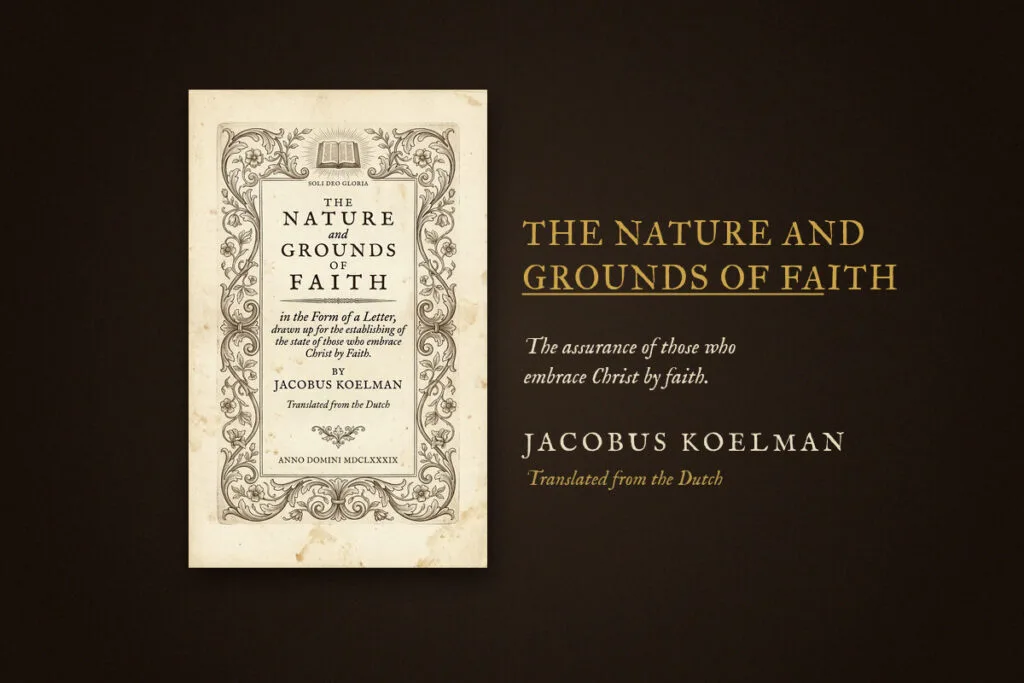
I’m working on translating a book he wrote back in 1689: The Nature and Grounds of Faith.
I discovered Koelman through Johan Blaauwendraad’s Salvation Has Become Complicated, a plea for a simpler account of how a sinner comes to Christ, which I wrote about here. Blaauwendraad reaches for Koelman’s Natuur en gronden des geloofs at just the point where the free offer of the gospel is in danger of being hedged about with conditions, citing Koelman to show that faith is simply “a giving of the hand… a willing subscription with the hand of the soul.” A friend recently mentioned the Koelman quote, which led to me re-reading Blaauwendraad recently, looking up the Koelman book in Dutch, falling in love with his work, and deciding to translate this book.
Who was Jacobus Koelman?
Jacobus Koelman (1631–1695) was one of the leading voices of the Nadere Reformatie—the “Further Reformation,” or Dutch Second Reformation, a movement within the Dutch Reformed Church that ran parallel to English Puritanism. Where the first Reformation had reformed the church’s doctrine, these men pressed for the reformation of its life: heartfelt and experiential godliness, strict keeping of the Lord’s Day, disciplined family worship, and a truly converted church membership. Koelman lived in the Dutch Golden Age, an era of remarkable commercial and intellectual energy, and much of his ministry was a protest that outward prosperity and a sound confession were no substitute for the inward power of true religion.
Born in Utrecht, he studied at its university under the great Reformed theologian Gisbertus Voetius and took a doctorate in philosophy in 1655. He served first as a chaplain to Dutch embassies in Copenhagen and Brussels, and then, in 1662, was called to the town of Sluis in Dutch Flanders, where he laboured for twelve years.
Those twelve years ended in collision. On grounds of conscience and Scripture, Koelman objected to two things then widely accepted in the Dutch church: the mandatory use of set liturgical Forms, and the observance of the Christian feast days, which he regarded as human inventions without warrant in the Word, and as rivals to the one holy day God had appointed—the Lord’s Day. In December 1672 he began to preach openly against the feast days; in January 1673, at a baptism, he laid the prescribed Form aside and spoke freely in its place. For this, he was suspended, deposed, and at last banished, escorted out of the Generality Lands in 1675, leaving a grieved congregation behind him. He spent the remaining twenty years of his life largely as a travelling preacher, gathering in private meetings and continuing to write, often under official pressure.
He was, in short, a precisian—heir to Voetius’s union of rigorous orthodoxy with warm, experiential piety, pressing the fine points of holy living and Sabbath-keeping, and a determined opponent of the newer currents (Cartesian rationalism, the Cocceian theology) he judged corrosive to godliness. He was drawn for a time to the reforming circle of Jean de Labadie, but broke with the Labadists when they turned to separatism, and remained within the Reformed church even as he laboured to reform it.
His most lasting service, though, was as a bridge. Koelman translated more than twenty English and Scottish Puritan and Covenanter works into Dutch—placing the heart-searching divinity of men like Christopher Love and Samuel Rutherford into Dutch hands. In an age of constant traffic between the Dutch and British Reformed worlds, he was one of the great channels through which British piety flowed into the Netherlands.
Why you have never heard of him
Here is the strange thing. Koelman gave the Dutch church the Puritans; but the Dutch church has never given him back. For all his importance, his own writing has remained almost entirely locked in the Dutch language. To date only one of his books—The Duties of Parents—has been published in English at all.
That is a real loss, and not only to scholars. Koelman wrote prolifically as a pastor: works of practical divinity, counsel, and controversy, aimed squarely at the helping the ordinary believer.
I haven’t looked at his other books, but The Nature and Grounds of Faith seems worthwhile to translate. His book is a great work that encourages true biblical Calvinism and refutes toxic Hyper-Calvinism. It’s important for a believer may to know that his/her faith is real, and rest in it.
What the book actually does
The treatise is, in form, a pastoral letter. Koelman writes to the ordinary believer who longs to be sure of his standing before God, and he states his purpose plainly at the outset: to set out the sure grounds on which a soul that has fled to Christ can, and must, conclude that all comfort, holiness, and salvation are laid up for it, and so to cut off the doubts that trouble Christians.
He goes about it with a pastor’s orderliness. He begins by clearing the ground, naming four kinds of persons who have no right to expect comfort in the condition they are in. Then he lays down, one after another, what saving faith is and is not. It is not the assurance that Christ died for me in particular—for a true believer may lack that assurance, and a hypocrite may have it. Nor is it a bare assent of the understanding, which even the devils give to the truth. Saving faith, rather, is the act by which the whole soul receives and embraces Christ as He is offered in the gospel, resting the entire weight of its salvation upon Him.
From there he builds: a long catalogue of the ways Scripture describes that act of faith; then sixteen distinct grounds on which a soul may rest its assurance; and finally twenty cautionary directions for the doubting and the weak. And along the way he argues that to exercise this saving faith is not hard but easy for anyone in whom God has begun His work, however feeble that person may feel himself to be.
The book moves the ground of assurance off the shifting sand of the believer’s feelings and onto the firm rock of what God has revealed and what faith actually does—and it does so with a tenderness toward the weak and doubting that has made it a comfort to Dutch readers for three centuries.
A taste of it
Here is Koelman describing the act of faith itself what it looks like when a soul truly closes with Christ:
The soul goes out heartily and takes refuge in Christ for righteousness, strength, help, and eternal life. It gives Him its hand and willingly signs, as it were, with the hand of the soul, that it will come to God and Christ for everything and receive it as a free gift; and at the same time it gives itself up and surrenders into the hands of Jesus, that He may forgive sin, and mortify and subdue it, and by His Spirit work peace, comfort, sanctification, fruitfulness in good works, growth in grace and perseverance in it, and at last full blessedness—and that in whatever way He sees fit.
Notice what that does to the assurance question. It does not ask you to descend into yourself and measure the heat of your affections. It asks a simpler and steadier thing: have you given Christ your hand? Have you fled to Him, and to no other, for everything? That is a question a trembling believer can actually answer.
What comes next
I am preparing The Nature and Grounds of Faith for print—as far as I know, the first time this treatise has been available in English. It has been translated from the public-domain 1895 Tulp edition (Zwolle) of Koelman’s De natuur en gronden des geloofs, with the aim throughout of faithfulness to his meaning and English that reads as English.
Over the coming weeks I will be posting from it here as the work goes on: the four kinds who have no ground for comfort, what saving faith is and is not, the sixteen grounds themselves, and some notes on the craft of bringing a seventeenth-century Dutch pastor into readable modern English. My hope is that this small corner of the internet can become the place where English readers finally meet Koelman.
If that interests you, subscribe below, and I will write to you the day the book is ready, along with the chapters I post here as I go.
May the Lord bless this old and tested treatise to its new readers, as He has blessed it to so many before them.


Great initiative!